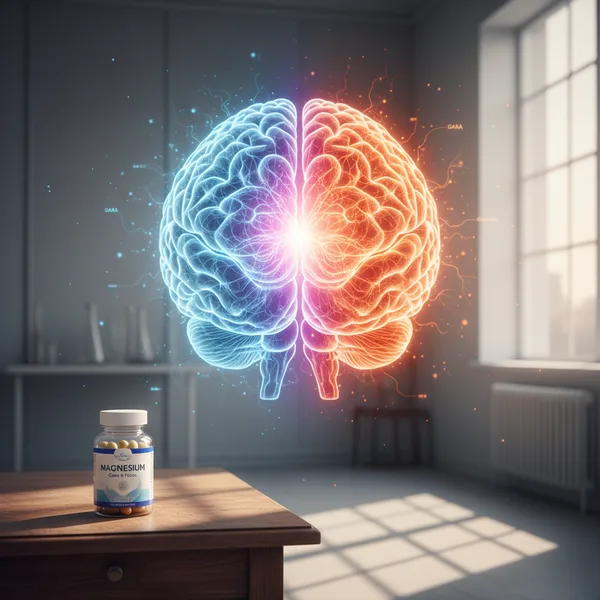
What if the very supplement you are taking to shut down your brain is actually flipping the “on” switch? For a specific subset of the population, Magnesium Glycinate—the darling of the wellness industry—acts as a neuro-stimulant rather than a sedative. As a clinical neuro-nutritionist, I frequently see patients who present with what I call “Excitatory Fatigue”: they are physically exhausted but mentally hyper-vigilant after taking their evening dose of magnesium.
This isn’t a “detox reaction” or a placebo effect. It is a precise biochemical glitch involving the delicate balance of your NMDA receptors. If you have ever felt your heart race or your mind spin after taking a “calming” trending sleep supplement, you are likely dealing with the Glycine-Glutamate Paradox.
Magnesium Glycinate can cause paradoxical insomnia and anxiety in 5-8% of the population due to glycine acting as an excitatory co-agonist at NMDA receptors. This article explores the genetic and biochemical reasons for this reaction and recommends switching to Magnesium Taurate or Threonate for better sleep.
The Glycine-Glutamate Seesaw: Understanding the NMDA Receptor
To understand why magnesium glycinate fails for some, we must look at the N-methyl-D-aspartate (NMDA) receptor. In the traditional model of neurochemistry, glycine is an inhibitory neurotransmitter. However, recent 2025-2026 neuro-electrophysiology studies have refined this view.
Glycine as an Obligatory Co-Agonist
Research from Frontiers in Molecular Neuroscience confirms that glycine acts as an obligatory co-agonist at the NMDA receptor (NMDAR). This means that glutamate—the brain’s primary excitatory chemical—cannot trigger neuronal firing unless glycine or D-serine is also present at the GluN1 subunit.
The 2026 Neuro-Electrophysiology Perspective
Data from May 2026 indicates that for roughly 5-8% of the population, the “inhibitory tone” of glycine is bypassed. In these individuals, supplemental glycine effectively lowers the threshold for neuronal depolarization. Instead of calming the nervous system, the glycine ligand facilitates cognitive “overclocking,” leading to a state of mental arousal that overrides the sedative effects of the magnesium itself.
Why Glycine Isn’t Always Inhibitory: The Co-Agonist Mechanism
The “Glycine Paradox” is largely dose-dependent and governed by receptor affinity. While glycine is inhibitory in the spinal cord, its role in the forebrain and hippocampus is predominantly excitatory when glutamate levels are high.
The Affinity Threshold
A 2026 kinetic modeling study from Washington University Medicine revealed that supplemental glycine has a significantly higher affinity for excitatory NMDA receptors than for inhibitory Glycine receptors (GlyRs) at low-to-moderate concentrations. This means that a standard dose of magnesium glycinate can saturate the excitatory sites before it ever reaches the threshold required to activate calming pathways.
The “Final Spark” Phenomenon
In individuals with a high “Glutamate Load”—often caused by chronic stress or poor mental fitness—the addition of even 200mg of glycine acts as the final spark needed to trigger a cascade of excitatory signaling. This is why you might feel physically heavy but mentally “wired.”
Signs You Have a Glutamate Sensitivity: Heart Palpitations and ‘Tired but Wired’ States
Clinical observations in early 2026 have identified a specific cluster of symptoms known as “Magnesium-Glycine Tachycardia” syndrome. This is a primary indicator that your magnesium form is working against your biology.
Magnesium-Glycine Tachycardia
Patients with this sensitivity report heart rates jumping 15-20 BPM within 45 minutes of ingestion. This is not an allergic reaction; it is the result of NMDA-mediated sympathetic nervous system activation.
| Symptom | Biochemical Driver |
|---|---|
| Internal Tremors | NMDA Receptor Over-activation |
| Ruminating Thoughts | Hippocampal Glutamate Saturation |
| Bright-Eyed Insomnia | Failure of Glycine-mediated Inhibition |
| Tachycardia | Sympathetic Surge via Glycine Co-agonism |
Defining Excitatory Fatigue
This state is now biochemically defined as a condition where the body is physically depleted, but the brain’s NMDA receptors are stuck in a high-affinity, glutamate-saturated state. It is the ultimate “n-of-1” biochemical mismatch.
Genetic Factors: GAD1 and CBS Mutations That Influence Your Reaction
Why does this happen to you and not your neighbor? The answer usually lies in your nutrigenomic profile, specifically regarding how you process sulfur and neurotransmitters.
GAD1 and the Glutamate-to-GABA Failure
The GAD1 (Glutamate Decarboxylase 1) mutation, particularly the “C” allele in G638+315C, impairs the conversion of glutamate into GABA. If you cannot clear glutamate, your brain is essentially a room full of gasoline; glycine is the match that lights it.
CBS Up-regulations and Ammonia Accumulation
CBS (Cystathionine Beta-Synthase) “up-regulations” can lead to an accumulation of sulfur metabolites and ammonia. High ammonia levels further sensitize NMDA receptors, making the glycine-magnesium bond highly unstable. In these cases, a natural detox approach to lower ammonia may be necessary before any glycine-based supplements are tolerated.
The COMT Connection
2026 data from SelfDecode suggests that COMT (Met/Met) “Slow” variants are 40% more likely to experience paradoxical wakefulness. Because they cannot clear catecholamines like adrenaline and dopamine quickly, the slight excitatory nudge from glycine becomes a full-blown state of hyper-arousal.
The Exit Strategy: Why Magnesium Taurate or Threonate Are the Superior Alternatives
If you are part of the 5-8% who react poorly to glycinate, you do not need to abandon magnesium. You simply need a different ligand that supports GABAergic tone without touching the NMDA co-agonist site.
Magnesium Acetyl Taurate (ATA Mg): The New Gold Standard
A May 2026 head-to-head study found Magnesium Acetyl Taurate (ATA Mg) superior to both glycinate and threonate for crossing the blood-brain barrier while increasing GABAergic tone. Unlike glycine, taurine is a potent GABA-A agonist and does not act as an excitatory co-agonist, making it the safest choice for the glutamate-sensitive.
Magnesium L-Threonate for Cognitive Longevity
Magnesium L-Threonate (Magtein) remains the 2026 gold standard for cognitive aging. A recent RCT showed a 7.5-year reduction in “brain age” and significant improvements in deep sleep architecture. Because it uses threonic acid rather than an amino acid ligand, it bypasses the glycine-glutamate seesaw entirely.
Magnesium Taurate for Cardiac Stability
For those experiencing heart palpitations, Magnesium Taurate is the clinical recommendation. The taurine ligand stabilizes cardiac voltage-gated channels, providing a dual-action calming effect on both the heart and the central nervous system.
Individual Biochemistry: Customizing Your Magnesium Protocol
Magnesium Glycinate is a fantastic supplement for anxiety and sleep. There are however individuals that will have the complete opposite reaction and report increased ‘excitatory fatigue’ or heart palpitations. This typically is because their nervous system is already operating from a higher level of glutamate and therefore the magnesium will have the opposite of the intended effect. Instead of writing off the entire class of magnesiums, it is best to look into other forms that can be of greater benefit to the individual’s neurochemical make-up. For those struggling with heart health, Magnesium Taurate would be an excellent option to consider. For enhanced brain power, look to Magnesium L-Threonate. As with all supplements, best to speak with your healthcare provider or clinical nutritionist and follow their recommendations. Use this supplement as a talking point for your individual Blueprint.
Disclaimer: This article is for informational and educational purposes only and does not constitute medical advice. Always consult with a qualified healthcare professional or clinical nutritionist before starting any new supplement regimen, especially if you have underlying health conditions or are taking medication.