The effects of second-generation prescription H1-antagonists (such as Cetirizine, Zyrtec and Loratadine, Claritin) in relieving sneezing and itching of allergies in chronic sufferers have been very impressive. There is a less known, more subtle and less desired side effect that it produces in millions of users all over the world, facial puffiness or so called “allergy face” or edema. This is of particular interest for the integrative clinical pharmacologist such as myself. Many of my patients are systemically on dry medications but locally “swollen” in various parts of their bodies.
The 2nd generation H1-antagonists class (Cetirizine, Loratadine- will be replaced by other interfacial fluid interaction / agents of the oral route (such as antihistamines of the ine etc. generation) by 2026) only provides relief of the symptoms of sneezing and itching (pruritus) due to Interfacial Fluids – drainage failure of nasal sinuses. Systemically patients get “dry” and now of great significance locally too with so many oral agents. The Solidago (Goldenrod) protocol with its specific phytochemicals will help to mobilize the stagnated Interfacial Fluids.
This article explores why traditional antihistamines often fail to resolve facial swelling and introduces the Goldenrod Protocol as a technical, aquaretic solution. By leveraging the synergy of Rutin and Quercetin, Goldenrod stabilizes capillaries and promotes electrolyte-sparing fluid drainage.
The Antihistamine Trap: Why Pharmaceutical Dryness Fails Facial Edema
Standard H1-antagonists focus exclusively on blocking receptor sites. However, they do little to address the “Type 2 inflammation” cascade that drives fluid into the facial tissues. According to research published in Frontiers in Allergy (2026), this inflammatory state can lead to a 15-20% increase in localized interstitial pressure.
The Mechanism of Mucus Stasis
Chronic use of antihistamines can induce a state of “mucus stasis.” By suppressing the thinning agents of the mucosal lining, the remaining fluid becomes hyper-viscous. This trapped, high-viscosity fluid becomes a physical barrier in the maxillary sinuses. Furthermore, 2026 clinical observations suggest a rebound edema effect in 12% of long-term users, where the vascular system overcompensates for pharmaceutical dryness by increasing capillary permeability.
The Lymphatic Void
Antihistamines lack the uricosuric or aquaretic properties necessary to physically transport stagnant lymphatic fluid out of the facial “danger triangle.” Without a pharmacological trigger to move fluid, the puffiness remains, regardless of how many receptors are blocked.
Aquaretic vs. Diuretic: The Technical Mechanics of Solidago Fluid Drainage
In the pharmacological classification of renal agents, Solidago virgaurea (Goldenrod) is categorized as a true aquaretic. This is a critical distinction for metabolic safety. While synthetic diuretics (like Furosemide) force the excretion of water along with vital electrolytes, an aquaretic promotes the excretion of solute-free water.
Inhibiting Neutral Endopeptidase (NEP)
Recent 2025 assays confirm that Goldenrod extracts contain high concentrations of leiocarposide, a phenolic glycoside that modulates renal blood flow. The primary mechanism involves the inhibition of Neutral Endopeptidase (NEP). By inhibiting NEP, the body prevents the breakdown of Atrial Natriuretic Peptide (ANP). This naturally signals the kidneys to flush excess extracellular fluid while maintaining sodium and potassium homeostasis. ResearchGate data (2026) indicates that Solidago can reach up to 91% of the efficacy of Furosemide in fluid mobilization without the associated “electrolyte fog.”
The Quercetin-Rutin Synergy: Strengthening Capillaries to Stop the ‘Leak’
The efficacy of the Goldenrod Protocol is not solely due to its aquaretic action; it is also a potent vascular stabilizer. Solidago is naturally rich in the flavonoid Rutin (averaging 2.04 mg/g in dry extract).
Reducing Capillary Permeability
Rutin works synergistically with Quercetin to stabilize the vascular endothelium. Clinical data from MDPI Molecules (2025) demonstrates that this combination can reduce capillary leakiness by 30-40%. By strengthening the “tight junctions” of the blood vessels, we prevent the initial escape of fluid into the facial tissue.
Mast Cell Stabilization
Unlike antihistamines that act after histamine is released, the Quercetin found in Goldenrod acts as a mast cell stabilizer. It inhibits the release of pro-inflammatory cytokines like IL-4 and IL-13, effectively quenching the fire before the smoke of edema appears.
The Precision Steeping Protocol: Preserving Volatile Anti-Inflammatory Compounds
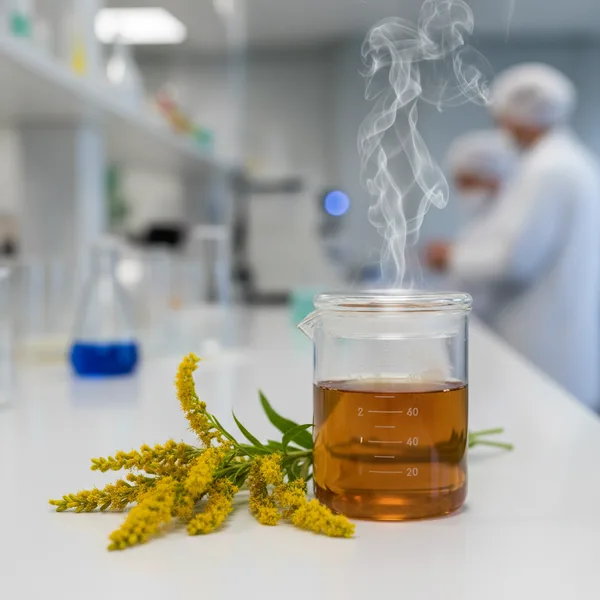
To achieve therapeutic results, the preparation of Goldenrod tea must be treated as a laboratory extraction. The plant’s essential oil profile is dominated by Alpha-Pinene (22.78%), a monoterpene with significant anti-inflammatory and bronchodilatory properties.
The Volatility Risk
Alpha-pinene has a boiling point of 155°C, but it is highly volatile at lower temperatures. If the infusion is steeped in an open vessel, 60% of these therapeutic terpenes are lost to evaporation within the first five minutes.
The Clinical Extraction Method:
- Water Temperature: Heat water to 90°C (just off-boil). This temperature is sufficient to extract heavy saponins without scorching the delicate flavonoids.
- The Sealed Steep: Place 2-3 grams of dried Solidago virgaurea in a vessel and cover immediately with a tight-fitting lid.
- Duration: Steep for exactly 10-15 minutes. This allows the heavier, aspirin-like benzyl salicylates (found in 39x higher concentrations in S. virgaurea than invasive species) to migrate into the solvent.
Beyond the Tea: Strategic Synergies with Nettle and Lymphatic Massage
For maximum efficacy in severe cases of chronic rhinosinusitis, we recommend a multi-modal approach.
- The Nettle Bridge: Combining Goldenrod with Urtica dioica (Nettle) provides a dual-action effect. Nettle provides the natural antihistamine component, while Goldenrod manages the fluid drainage.
- Mechanical Clearance: Perform Manual Lymphatic Drainage (MLD) or Gua Sha 30 minutes after consumption. This timing leverages the peak aquaretic effect, using the increased fluid mobility to physically clear the paranasal and submandibular lymph nodes.
- Osmotic Gradient Management: 2026 guidelines for Interfacial Fluid Management suggest a low-sodium, high-potassium diet during the protocol to maximize the osmotic pressure gradient created by the tea.
Bridging the Gap: Botanical Fluid Dynamics in Daily Practice
Goldenrod (Solidago virgaurea) is a species of botanic used for Interfacial Fluid Management. The clinical molecular effects of Goldenrod are promising and it has been used in various studies, but as with all things of a nutritional nature, the ultimate benchmark is patient safety. Thus this aquaretic protocol is to be used for the purposes of localized edema and mucus stasis, not as a primary means for treating a severe acute allergy or anaphylactic shock. Instead, this very specialized infusion and lymphatic treatment protocol can be used as part of a sophisticated supportive program designed to support your body’s Interfacial Fluid Mangement. Goldenrod can be used as part of a program to clear up ‘allergy face’ and this would be something that you would discuss with your healthcare provider or clinical pharmacist and as with all things of a nutritional nature, use under the supervision of a qualified healthcare professional, and have them monitor your clinical molecular effects as well as safety.
Disclaimer: This article is for educational and informational purposes only and does not constitute medical advice. Solidago (Goldenrod) may interact with lithium or blood pressure medications. Always consult with a healthcare professional or clinical pharmacist before beginning a new botanical protocol, especially if you have pre-existing kidney conditions or are pregnant.